Pulling off brunch cocktails for a crowd comes down to three things: the drink has to batch cleanly, it has to hold for at least an hour without turning flat or bitter, and it has to land with guests whose tolerance ranges from bottomless-mimosa to one-glass-and-done. The builds that reliably clear all three bars are the Bloody Mary, mimosa variations (not just orange juice), big-batch margarita, a sparkling gin punch, and a well-made non-alcoholic option. Between those five, most tables are covered.
The single principle that separates a crowd-ready recipe from a scaled-up single-serve is this: dilution control and carbonation timing are one problem, not two. Scale without adjusting, and two failures follow — either you over-dilute a pitcher that's been sitting for forty minutes, or you add sparkling wine too early and serve flat mimosas to the last six guests. The root cause is the same in both cases: a cocktail built for one gets diluted in the shaker and carbonated at pour, assumptions that collapse the moment you multiply the recipe by eight, because the ice keeps working and the bubbles keep escaping whether you're watching or not. Every recipe that actually works at scale solves for those two variables first — how much water the ice is adding over time, and exactly when the bubbles go in.
What makes a cocktail work for a brunch crowd (and most don't)
Four things determine whether a cocktail actually functions at scale: it has to batch without degrading, hold for at least an hour without a minder, appeal to people with different palates, and require almost nothing from whoever is hosting. Most drinks fail at least two of those tests.
Carbonation and fresh citrus are the first casualties. CO₂ escapes fast. A sparkling drink built two hours before guests arrive is flat before anyone pours a glass, and freshly squeezed lemon or lime juice turns dull and slightly bitter as it sits — both problems compound each other in a large open vessel. Fine for service, disastrous for prep.
Dilution is sneakier. A two-quart pitcher chills and dilutes at roughly the rate a recipe assumes. A twelve-serving dispenser sitting on a table does something different — the ice-to-liquid ratio shifts as the batch level drops, and the last pours land noticeably weaker than the first.
Then there's the crowd itself. Not everyone drinks bitter aperitifs. But boozy-forward builds at 11 a.m. also polarise a table in ways that become socially awkward once the host notices half the glasses are still full and no one has said anything. If a drink alienates a third of the room before it's even poured, it isn't a crowd cocktail — it's a specialty order wearing one.
The bartender-effort ceiling matters more than most hosts expect. Any drink that pulls the host away for more than ninety seconds per round will eventually stop being made.

The Bloody Mary: the most forgiving batch cocktail at brunch
Of all the brunch cocktails for a crowd, the Bloody Mary is the one that actually gets better the longer you ignore it. Make the base the night before — tomato juice, Worcestershire, prepared horseradish, lemon juice, and celery salt, with the vodka kept on the side to add at roughly one part vodka to four parts base — and those flavors knit together in a way that a same-morning batch never quite achieves, because the horseradish in particular softens from sharp to savory over those hours, which is the difference between a drink that bites and one that finishes clean. That alone justifies the advance work.
The ingredient people consistently miscalculate is hot sauce. Heat perception amplifies across a large volume. What tastes mild on a tasting spoon can cross into punishing territory once it's scaled into a 32-ounce pour and someone drinks half of it before the eggs arrive, so add it in stages — a conservative amount the night before, then a second calibration the morning of — and keep extra on the side for guests who want more.
⚠️ A garnish station does something practical beyond the spectacle of bacon and pickled okra skewers: it occupies guests. While people assemble their own glass, assembling your own means you're not fielding requests, topping up drinks, or explaining to someone's aunt why there's no champagne — and that's a solid 20 minutes you get back without anyone noticing you've stepped away.
Mimosa variations that scale beyond the basic orange juice pour
The standard mimosa — orange juice, cheap bubbles, done — scales fine, but it bores everyone by the second glass, reliably, without fail, no matter how good the crowd is. Three variations hold up just as well in volume: blood orange with a splash of grenadine for winter and early spring, mango or guava juice for summer, and fresh-pressed apple cider stirred with a pinch of cardamom come fall. Seasonal anchoring isn't precious.
The single rule that saves every mimosa batch: never combine sparkling wine with juice in a pitcher. Carbonation dies fast. Add juice to individual glasses — roughly two parts juice to three parts sparkling — then pour the wine over it at the table, because once citrus acids are working against bubbles inside a shared vessel, the fizz is gone well before anyone has had a chance to sit down and reach for a glass. Skipping this step costs you half your fizz before anyone's seated.
On sparkling wine: Cava runs drier and holds its bubbles slightly longer than most Proseccos at the same price, which matters when you're opening eight bottles and the last few glasses still need to feel alive. For more on one of these styles before you shop, see WhatDrink's Prosecco guide. Domestic brut works too.
Pre-juicing fresh blood oranges or mangos that morning makes a visible difference in brightness — bottled juice tastes cooked by comparison, and that flatness compounds once it's diluted with wine.

Big-batch margarita and gin punch: the two builds worth making in a dispenser
Of all the spirits-forward options, these two hold structure in a large-format vessel better than almost anything else — the margarita because its acid backbone stays bright, the gin punch because it reads as approachable to guests who wouldn't order gin on purpose.
For the margarita, the ratio that scales without flavor drift is 3 parts tequila, 2 parts fresh lime, 1.5 parts triple sec — which you can read about alongside a classic margarita build using triple sec. Pre-dilute. Add 15–20% water by volume before refrigerating, because a dispenser sitting on a brunch table for two hours will melt whatever ice you put in it, and that slow, uneven dilution is what makes the third glass taste flabbier than the first — mixing the water in upfront removes the variable entirely. Most people skip this step.
The gin punch is a different animal. Cucumber, elderflower, lemon, and a restrained gin base together produce something that guests who claim to dislike gin will drink without complaint — the sparkling water goes in at service, not the night before, to preserve the lift.
⚠️ On the vessel question: dispensers are worth the counter space once you're serving ten or more people. Pitchers lose temperature faster and require near-constant refilling, which is exactly the kind of task that turns a host into a bartender.
Get Your Venue Discovered
List your venue on WhatDrink so people searching for their next drink by style, location and occasion can find you.
List Your VenueHow much alcohol does a brunch batch actually need — and what changes for health-conscious guests
A batched brunch cocktail's strength depends heavily on the build — a mimosa is mostly juice and sparkling wine, while a pre-diluted batch margarita is much stronger — and either can be stronger than people assume when they're refilling a plastic cup at 11am. That range is worth knowing before you build anything.
Food slows absorption. It does not, however, neutralize the arithmetic that accumulates across a three-hour brunch where someone works through four mimosas — every one of them still carries a real pour of sparkling wine, regardless of how much quiche was involved. If your batch is generous on the pour, that number climbs faster than guests realize.
The better approach for health-conscious guests isn't a separate "lighter" option that announces itself as such. Swap the sparkling wine for a low-ABV sparkling alternative — the flavor profile stays interesting and the strength drops without the drink reading as a concession. In a Bloody Mary or pitcher margarita, reduce the spirit by a third and replace the volume with cold-brewed herbal tea or a lightly flavored sparkling water. The texture holds; the difference is subtle.
One small hosting detail that earns disproportionate goodwill: write the ABV range on a small card next to each dispenser. Guests who want to self-regulate can do it without having to ask.
For anyone at the table building their own drink list with calorie or ABV constraints in mind, this guide to lower-calorie cocktails you can make at home covers a range of options organized by occasion — the limitation being that the recipes are individual-serve rather than batch-scaled, so some conversion arithmetic is required.
Non-alcoholic brunch drinks that hold up in a batch
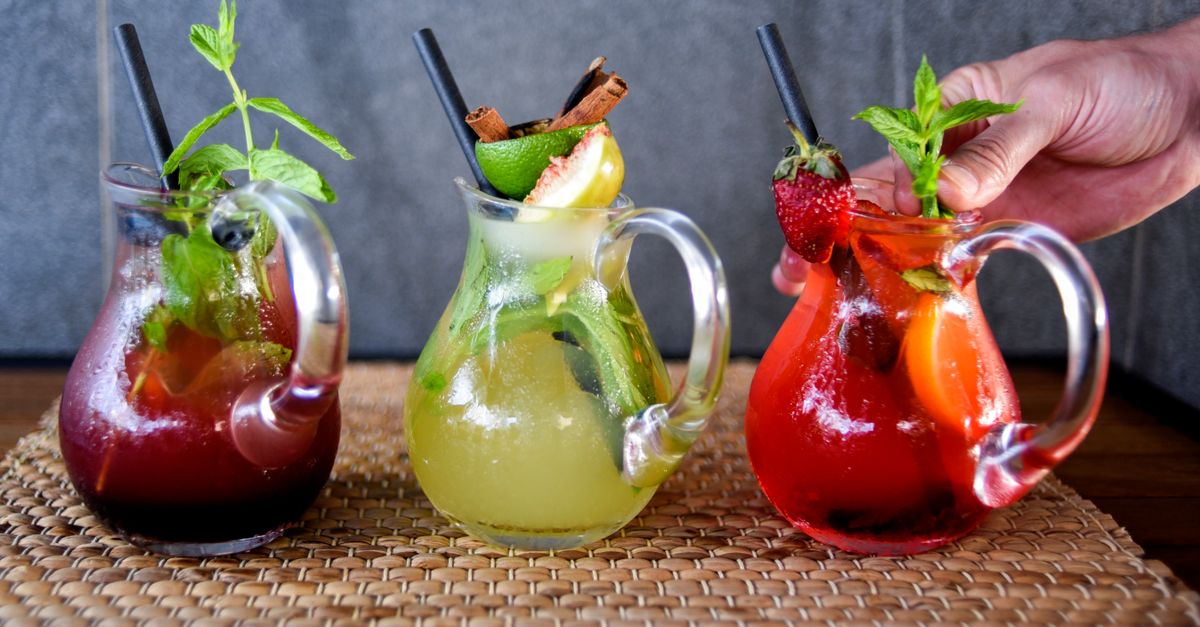
The best NA option at a brunch isn't sparkling water with a lemon wedge — it's a batch that took as much thought as the Bloody Mary next to it. Two builds earn that standing: a shrub-based punch and a cold-brew tea spritz.
A shrub — fruit macerated with sugar, then sharpened with vinegar — adds the kind of complexity that plain juice simply can't deliver. Make it 48 hours ahead; the flavor deepens considerably overnight. Raspberry-apple cider vinegar is a reliable pairing. Cold-brew tea with orange zest and a sparkling top-up at service is the option that doesn't read as a consolation prize; steep it overnight, refrigerate, and add the carbonated water when guests arrive. Both hold in a dispenser without degradation.
The labeling matters. Give the NA station its own signage and the same glassware as the alcoholic batches — not a separate jug tucked beside the orange juice, which signals afterthought more loudly than any host intends. Guests who aren't drinking notice, and they appreciate not being reminded of the fact.
FAQ
What are the most popular brunch cocktails for a large group?
Bloody Marys, mimosas, and batch margaritas are the most consistent crowd-pleasers at brunch gatherings because all three tolerate advance preparation and work at almost any scale. A Bloody Mary base mixed the night before and a mimosa bar where guests pour their own sparkling wine cover most crowds with minimal morning effort. Batch margaritas in a dispenser suit groups of 12 or more — especially when a non-alcoholic option like a shrub punch sits alongside, giving every guest an appealing pour without any extra morning scramble.
How far in advance can I make batch brunch cocktails?
Most batch brunch cocktails — Bloody Mary bases, shrub punches, juice-forward gin punches — can be made 12 to 24 hours ahead without any loss of quality, and the Bloody Mary base actually improves overnight as the spices integrate. Sparkling components like Prosecco or soda should never be batched early. Add them immediately before guests arrive, or set them out for self-serve so carbonation stays intact. Citrus juice for margaritas is the one exception to the overnight rule — squeeze it the morning of, since it turns bitter and flat after more than 8 hours.
What is the easiest crowd-pleasing cocktail to serve at brunch?
A mimosa bar wins on simplicity. Chill the Prosecco or Cava the night before, set out juice options in small pitchers, and guests handle the rest themselves — no batching, no dispenser, no prep beyond the shopping. For hosts who want one poured drink rather than a self-serve station, a pre-mixed Bloody Mary base that guests ladle over ice is a close second, requiring nothing more than a garnish tray and a few minutes of refrigerator space.
What to Make the Night Before vs. the Morning Of
For a group of 8 or fewer, two builds cover everything: a Bloody Mary base made the night before and a mimosa bar assembled the morning of. The night-before work takes about 20 minutes — combine the tomato base, Worcestershire, hot sauce, horseradish, lemon juice, and your seasoning, then refrigerate it in a sealed pitcher. That's it until morning. When guests are an hour away, pull out the Prosecco to come to serving temperature, set juice options in small pitchers on ice, and put the Bloody Mary base on the table with vodka on the side so non-drinkers can pour a virgin version. Nothing gets diluted, nothing goes flat, and you are not doing anything complicated while people are already at your door.
For 12 or more, add two things: the batch margarita and the NA shrub punch. Both go into the prep schedule the night before. Mix the margarita's tequila, triple sec and a small amount of agave syrup and refrigerate it in the dispenser vessel; squeeze the lime juice the morning of and add it then, since fresh lime juice turns bitter and flat after more than 8 hours. The shrub punch base, which is just fruit juice, apple cider vinegar, and whatever spice or herb you've chosen, also goes in the refrigerator overnight in a separate pitcher.
Morning-of tasks for the larger group are mostly assembly. Two hours before guests arrive: load ice into the dispenser, pour in the margarita batch, and salt the rim of a glass set nearby as a visual cue. Forty-five minutes out: add sparkling water to the shrub punch pitcher, taste it, adjust with a splash more vinegar or juice if the carbonation has knocked the balance off, then transfer it to its serving vessel over ice. Thirty minutes out: set up the mimosa station — Prosecco bottles in an ice bucket, juice in pitchers, done. The Bloody Mary base comes out of the refrigerator last, about 15 minutes before people arrive, so it isn't sitting at room temperature longer than necessary.
One task remains after that. Put vodka and tequila on the table, label the NA option clearly so no one has to ask, and set out garnishes — though the sequence that got you here matters more than any individual recipe, because everything that can be cold and ready the night before should be, leaving the morning free for the table rather than the kitchen.